
The objection sounds reasonable: “My customers are gun guys. They are not going to download an app to book a lane.”
But here is the thing about “gun guys”—they are also restaurant guys, movie guys, golf guys, and travel guys. And in every one of those contexts, they are already using a venue-branded app to book, buy, and check in. 60% of all hotel reservations in 2024 were made on mobile devices (Prostay 2025). Booking.com’s app alone had 135 million active mobile users and 66 million downloads in 2024 (Business of Apps 2026). OpenTable serves over 60,000 restaurants with a reservation system so ubiquitous that “I’ll make an OpenTable” has become a verb.
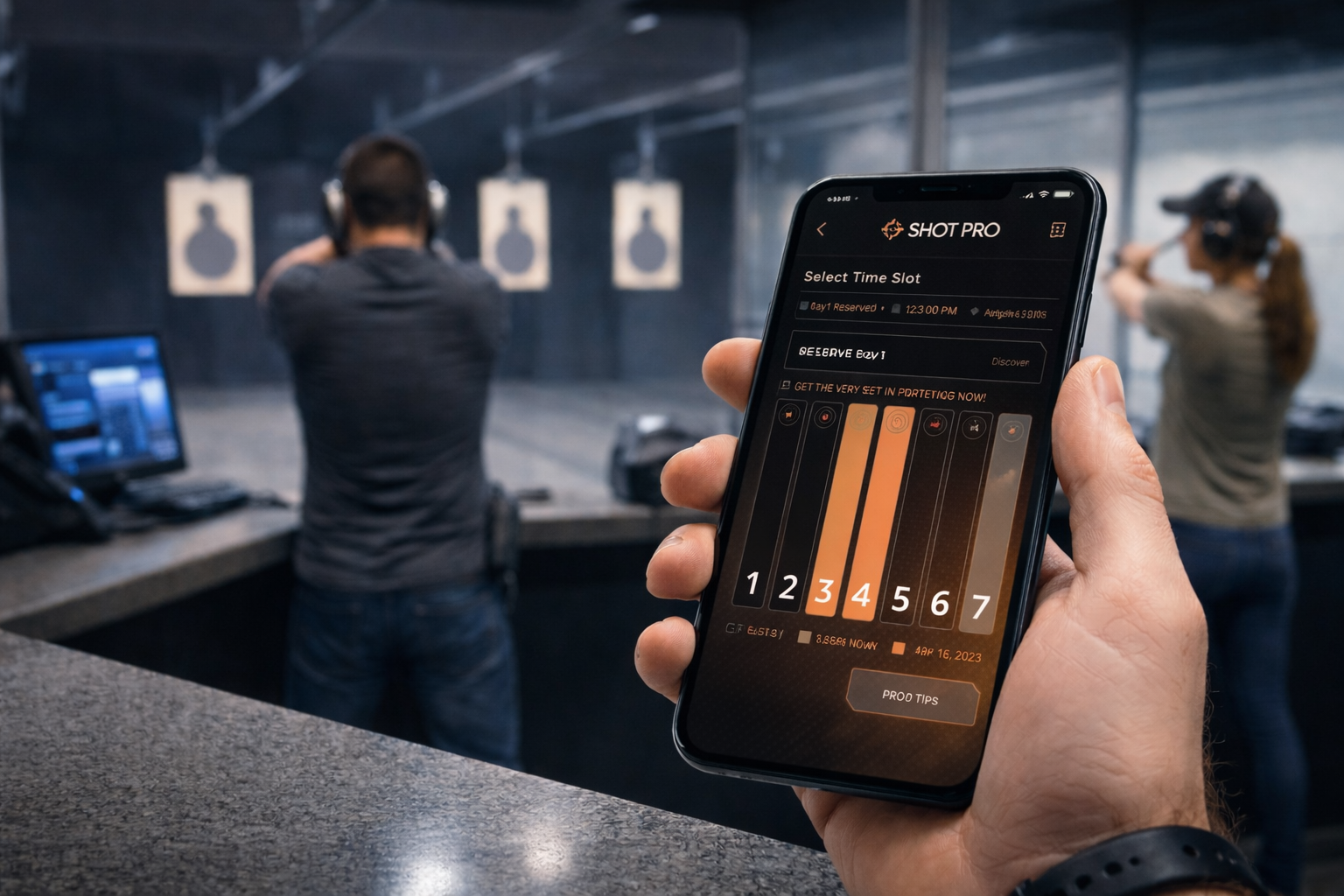
Your customers do not resist venue apps. They resist bad ones. A co-branded range app that delivers real value—lane booking, product purchasing, class registration, and personalized recommendations—is not asking customers to change their behavior. It is meeting them exactly where they already are.
The Consumer Expectation: Mobile-First Is the Default
The shift to mobile-first venue experiences is not a trend. It is a completed migration. 80% of travelers say booking entirely online is essential, with millennials and Gen Z leading adoption rates (Navan 2025). In the restaurant industry, online booking platforms have produced a 30% increase in repeat customers (LLCBuddy 2025). Restaurants with online reservation systems increased their table turnover rate by 15% simply by moving bookings to digital.
Topgolf understood this early. Every player needs a membership card to compete, and the Topgolf app handles bay reservations, scoring, food and drink ordering, and event booking in a single interface. Regal Cinemas built its Crown Club rewards program directly into its app—tickets, concession deals, loyalty credits, and showtimes all accessible without ever speaking to a person behind the counter. These are entertainment venues. So is your range.
The pattern across every successful venue app is identical: reduce friction, increase frequency, capture data. When a customer can book a lane in thirty seconds from their couch, they book more often. When they can browse your class schedule and register with two taps, they try classes they never would have asked about in person. When they can buy ammo and accessories in the app and pick them up at the counter, your average transaction value goes up without a single upsell conversation.
Push Notifications: The Channel That Replaces Email and SMS
Here is where the economics get interesting for range owners. Most ranges communicate with customers through two channels: email and SMS. Both are effective. Both are also increasingly expensive and increasingly ignored. The average email open rate across industries is 15–25%. The firearms industry does better than most—a 3.69% click rate, the highest of any industry (Omnisend 2025)—but that still means more than 96% of your email recipients are not clicking.
SMS is more effective at getting seen—98% open rate—but it costs money on every send. Commercial SMS messages run $0.01–$0.05 per message (Textline 2025), and at scale, the costs add up fast. A range sending 10,000 messages a month pays $400–$500 in messaging fees alone, before platform costs. And consumer tolerance for marketing SMS is declining: 71% of users will unsubscribe if they receive too many irrelevant texts (Omnisend 2025).
Push notifications change the equation entirely. They are free to send through your own app, they achieve open rates up to 90% (WiserNotify 2025), and they have a 28% average click-through rate—outperforming email in every industry studied (MobiLoud 2025). App users who receive push notifications in the first 90 days show 190% higher retention rates than those who do not (Airship). That is not a marginal improvement. It is a structural advantage.
And within the notification channel itself, the difference between generic and targeted messaging is dramatic. Targeted push notifications achieve a 39% retention rate compared to 21% for broadcast messages (Business of Apps 2025). Basic personalization improves open rates by 9%, while advanced personalization boosts reaction rates by up to 400% (Business of Apps 2025). The app is not just a cheaper channel—it is a smarter one, because it knows who each customer is and what they actually care about.
The Cost Comparison
Consider a range with 5,000 active customers. Sending one promotional message per week via SMS costs approximately $200–$1,000 per month depending on message length and provider. The same message delivered via push notification through your co-branded app costs zero in per-message fees. Over twelve months, a range can save $2,400–$12,000 in direct messaging costs while reaching customers through a channel that delivers higher engagement. The app does not just improve customer experience—it eliminates a recurring operational expense.
AI-Powered Recommendations: The Revenue Multiplier
The most powerful argument for a co-branded range app is not booking or notifications. It is personalized recommendations driven by artificial intelligence. When your app knows a customer’s visit history, class completions, skill level, and purchase patterns, it can deliver recommendations that feel helpful rather than salesy.
Skills Progression. “You’ve completed Basic Pistol and Defensive Fundamentals. Ready for Advanced Pistol? Next class is Saturday at 10 AM.” This is the Duolingo model applied to shooting sports—a progression pathway that keeps customers engaged and advancing. 48% of mobile app users made an in-store purchase after receiving a push notification triggered by profile data (Invesp). When the recommendation is relevant to where the customer actually is in their journey, conversion rates climb.
Product Recommendations. “Based on your last three visits, shooters like you have upgraded to the Springfield Hellcat Pro. In stock now—reserve yours.” This is the Amazon model: relevant, data-driven suggestions that surface at the right moment. Users who engage with personalized push notifications show 39% retention rates (11+ sessions) compared to 21% for broadcast messages (Business of Apps 2025).
Class and Event Discovery. “New this month: Date Night at the Range—dinner and lanes for two. Book now before it sells out.” Experiential dining bookings on OpenTable grew 27% year-over-year in 2025 because consumers responded to curated, experience-based recommendations (OpenTable 2026). Your range has the same opportunity to surface events that customers did not know existed.
Adoption Is Not the Challenge. Value Is.
The data on app adoption is overwhelming. 60% of people agree to receive push notifications (WiserNotify 2025). 65% of users return to an app within 30 days when push is enabled. Sending one onboarding push notification in a user’s first week increases retention by 71% over two months. The technology works. The channel works. The economics work.
What determines whether your range app succeeds or fails is whether it delivers enough value that customers keep it on their home screen. The apps that win—OpenTable, Topgolf, Regal, Booking.com—share three characteristics: they make the core transaction faster (booking), they reward repeat behavior (loyalty credits and personalized offers), and they surface things the customer would not have discovered on their own (classes, events, products).
A co-branded range app that does all three is not a nice-to-have. It is the same competitive advantage that every other venue-based business has already deployed—delivered in your brand, on your customer’s phone, working for you twenty-four hours a day.
The Data Advantage: Own Your Customer Relationship
There is a strategic dimension to a co-branded app that goes beyond convenience and cost savings: data ownership. When your customers book through a third-party platform, that platform owns the customer data. When they book through your app, you own it.
This is the lesson the hotel industry learned the hard way. Hotels that relied exclusively on OTAs (Expedia, Booking.com) for reservations paid 15–25% commissions and lost direct customer relationships. The industry response was aggressive investment in direct booking—and it worked. Direct hotel bookings increased from 20% to 29% between 2024 and 2025 (LLCBuddy 2025), driven by loyalty programs and mobile app experiences that gave customers a reason to book directly.
Your range app serves the same function. Every booking, every purchase, every class registration that happens in your app is data that belongs to you—data you can use to segment customers, personalize communication, identify churn risks, and optimize your programming. Without an app, you are flying blind between visits. With one, you have a real-time window into your customer base that no amount of email blasting can provide.
And the booking behavior data alone is transformative. Restaurants with online reservation systems see a 15% increase in table turnover rate and a 30% increase in repeat bookings (LLCBuddy 2025). These gains come not from operational changes on the floor but from reducing the friction between the customer’s intent to visit and their actual visit. When booking is easy, visits go up. When visits go up, revenue follows. The app is the mechanism that converts intent into action.
The Generation That Is Coming
One final data point for range owners thinking about the next five years rather than the next five months. Gen Z and millennials are more likely to abandon a customer service issue if it cannot be resolved through self-service(Gartner). They do not want to call your front desk. They do not want to stand in your lobby. They want to open an app, book a lane, check their class schedule, and show up ready to shoot.
The 26.2 million Americans who purchased their first firearm between 2020 and 2025 skew younger, more diverse, and more digitally native than any generation of gun owners before them (NSSF). These customers will not ask whether your range has an app. They will assume it does—and if it does not, they will find a range that does.
The Engagement Flywheel: Why Apps Compound Over Time
The most underappreciated advantage of a co-branded range app is the compounding effect on customer lifetime value. Users who opt in to push notifications are retained at nearly 2x the rate of users who do not (Airship). Users who receive personalized notifications show 3x higher retention rates than those who receive generic messages (MobiLoud 2025). And a 5% increase in user retention can result in a 50% boost in business value(WiserNotify 2025).
Each of these effects compounds over time. A customer who downloads your app, books their first lane, receives a welcome notification, completes their first class, and gets a personalized recommendation for the next one is on a flywheel. Each touchpoint deepens engagement. Each engagement drives the next visit. Each visit increases lifetime value. This is the model that Netflix, Spotify, Amazon, and every successful subscription business has perfected—and it starts with the app on your customer’s phone.
Consider the restaurant parallel once more. OpenTable’s 2026 dining trends report found that group dining reservations for parties of six or more rose 8% and mid-week dining increased 11% year-over-year (OpenTable 2026). These gains did not come from better food or bigger marketing budgets. They came from an app that made booking so easy that customers booked more frequently, tried new times, and brought more people. The technology did not change the product. It changed the frequency of engagement with the product. That is what a range app does.
The Implementation Advantage: Co-Branded, Not Custom
The fastest path to a range app is not building one from scratch. Custom app development costs $50,000–$250,000, takes six to twelve months, and requires ongoing maintenance that most ranges cannot staff or afford. A co-branded app—your brand, your colors, your content, built on a proven platform—delivers the same functionality in weeks rather than months, at a fraction of the cost.
This is the model that works across every industry. Regal Cinemas does not build its own app infrastructure from scratch. Neither does every independent restaurant on OpenTable. They leverage a platform that handles booking, payments, notifications, and loyalty—and they brand it as their own. The result: a professional app experience that customers trust, delivered at a price point that small and mid-size venues can afford. The same model applies to ranges.
The bottom line is not about technology. It is about meeting your customers where they already live: on their phones, expecting convenience, rewarding the venues that deliver it, and leaving behind the ones that do not.
ShotPro’s biometric check-in technology integrates facial recognition with digital waivers, age verification, and membership management—giving your customers the fast-pass experience they already expect from every other venue they visit.
© 2026 ShotPro Technologies. All rights reserved.