
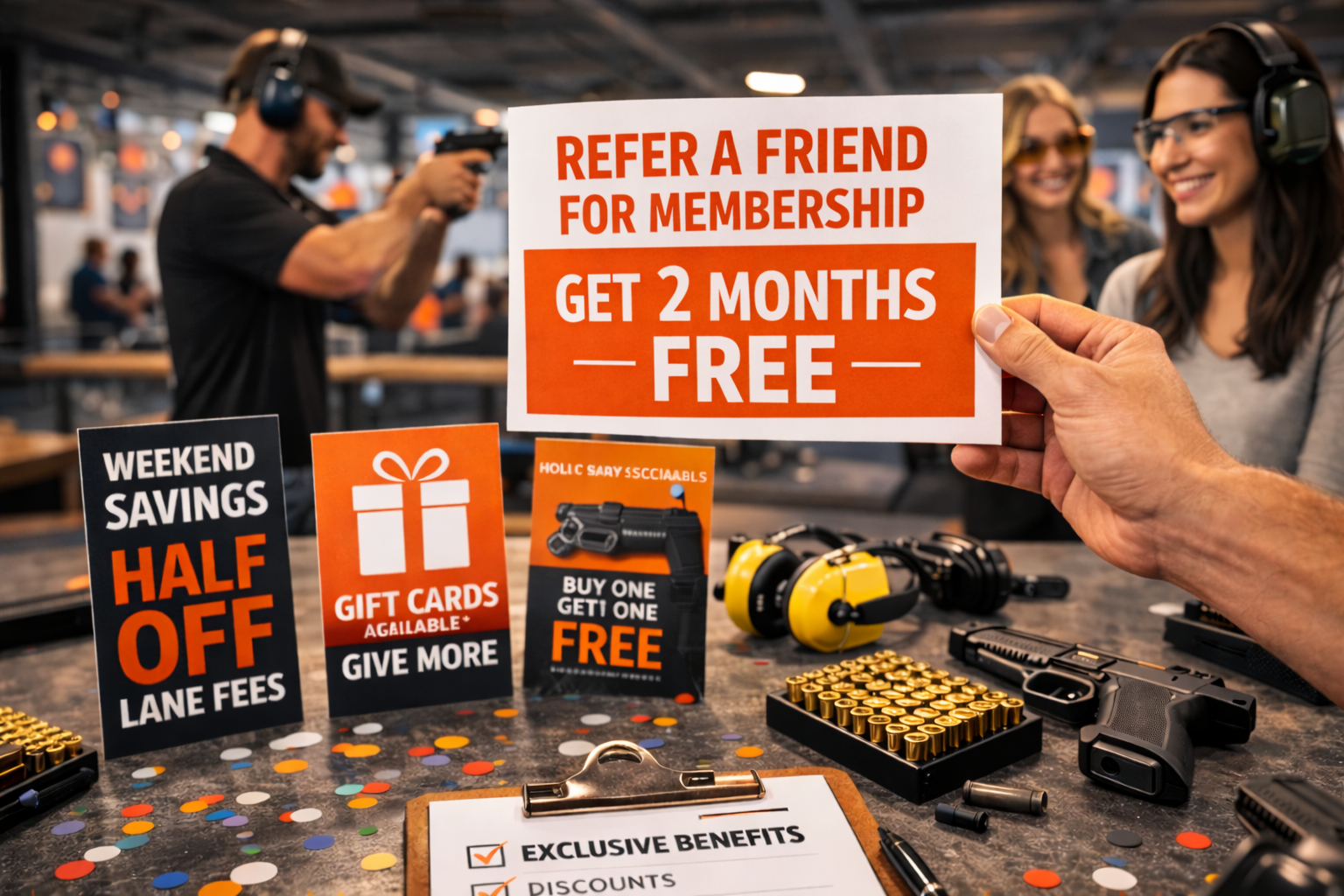
The most dangerous promotion is the one that trains your customers to wait for a discount. The most profitable promotion is the one that gives them a reason to come back sooner.
Most shooting ranges run promotions the same way: a Black Friday deal in November, a Father’s Day special in June, maybe a “New Year, New Skill” campaign in January—then silence for the other nine months. The result is predictable: revenue spikes around a handful of holidays and flatlines the rest of the year. Worse, the promotions themselves are usually straight discounts—“20% off lane time” or “Half-price rentals”—that erode margin without building long-term customer value.
The data on promotional marketing tells a more compelling story. Bundle promotions increase average order size by 35%. Consumers who receive relevant promotions are 50% more likely to make a purchase. Eighty percent of consumers are more likely to buy from brands that offer personalized promotions. And the most effective promotional channels—email, social media, and SMS—are the same channels most ranges already have but dramatically underuse. The opportunity is not to promote more. It is to promote smarter, more consistently, and with a strategy that builds value instead of giving it away.
The Three Promotion Pillars
Before you plan a single campaign, understand that not all promotions serve the same purpose. Every promotion you run should fall into one of three categories, and a healthy promotional calendar balances all three throughout the year.
Pillar 1: Revenue Drivers
These promotions are designed to increase the average transaction value of customers who are already coming through the door. They do not discount—they bundle. Examples: a “Train & Test” package that combines a safety course with a live-fire session at a bundled price; an “Ammo + Targets + Range Time” one-click package; a “Class + Membership” deal that gives a bonus month free when a customer signs up after a class. Revenue drivers work because they increase spend per visit without reducing margin on any individual line item.
Pillar 2: Traffic Builders
These promotions are designed to bring new people through the door or bring existing customers back more frequently. They may involve a discount or free element, but the goal is customer acquisition, not margin maximization. Examples: “Bring a Buddy, Shoot Free” (where the paying customer covers the cost and the buddy is your new prospect); “First-Timer Weekend” with 50% off a first visit package including gear; community open house events with free orientation sessions. Traffic builders are investments, not giveaways. Measure them by new customer acquisition and return visit rates, not by same-day revenue. [See our companion article: Turn First-Time Visitors Into Lifetime Members]
Pillar 3: Engagement Builders
These promotions are designed to deepen relationships with existing customers and strengthen community bonds. They do not generate immediate revenue—they generate loyalty, referrals, and retention.Examples: member-only social events, loyalty punch cards (10 visits = free range session), social media contests (best target photo wins a class), and customer appreciation nights. The fitness industry has proven that exclusive member events increase retention by 15% and that community-oriented features drive 13–24% higher retention rates. Engagement builders are the cheapest promotions to run and the hardest to measure—but they are the ones that keep your members from canceling. [See our companion article: How to Build Community Engagement for Your Shooting Range]
The 12-Month Promotional Calendar
Consistency beats intensity. A range that runs one thoughtful promotion per month, planned in advance and marketed across all channels, will outperform a range that runs two massive sales per year. Here is a quarterly framework that balances all three pillars while leveraging natural seasonal demand.
Q1: January – March (Resolution & Training Season)
January: “New Year, New Skill” training promotion. Bundle a beginner class with a 30-day trial membership. This captures the resolution crowd and feeds your membership pipeline.
February: “Date Night at the Range” couples experience—a Valentine’s alternative that positions your range as a unique date destination. Bundle range time, instruction, and a social component. Promote heavily on social media to reach non-traditional audiences.
March: “Women’s Empowerment Month” ladies’ programming push. Launch or highlight your women’s classes, partner with local women’s organizations, and offer a “Bring a Friend” incentive that builds your female customer base. [See our companion article: Marketing to Women, Families & First-Time Shooters]
Q2: April – June (Growth & Outdoor Season)
April: “Spring Into Safety” concealed carry and home defense class promotion. Bundle the class with a follow-up range session to practice skills.
May: Mother’s Day “Ladies & Lead” event—a social shooting experience designed for moms and daughters, moms and friends, or any women looking for a non-traditional Mother’s Day activity.
June: Father’s Day gift card push and “Family Fun Day” weekend event. Gift cards are a critical revenue tool: U.S. gift card sales reached $308 billion in 2024, and 71% of customers report higher brand loyalty after receiving a gift card. A Father’s Day gift card campaign drives immediate revenue and guarantees a future visit.
Q3: July – September (Summer & Social Season)
July: “Independence Day Shoot” patriotic event with competitions, prizes, and community gathering. This is your biggest engagement builder of the year—designed to fill your range on a holiday weekend and generate social media content.
August: “Summer Ammo Special” volume promotion on ammunition and range time. Pair with a “Beat the Heat” indoor activity campaign that positions your air-conditioned range as the smart summer destination.
September: “Back to the Range” campaign targeting families returning to routines. Launch fall class schedules and offer an early-bird discount for class registration. This is also prime season for corporate team-building outreach as companies plan Q4 events. [See our companion article: Attracting Corporate Events & Private Parties]
Q4: October – December (Retention & Gift Season)
October: “Fall Tactics Week” featuring advanced training promotions, night shoots (if applicable), and a member appreciation event. This deepens engagement with your most committed customers heading into the holiday season.
November: Black Friday “Experience Bundles”—not discounted range time, but packaged experiences (class bundles, membership deals, gift packages) sold at compelling but margin-positive prices. Promote membership annual plans at the best rate of the year.
December: Holiday gift card push. This is your single highest-opportunity promotional month for gift cards, which function as both immediate revenue and guaranteed future traffic. U.S. gift card sales reached $308 billion in 2024, and 64% of consumers purchase gift cards during the holiday season. Forty-eight percent of gift card sales occur outside of December, so extend your gift card campaigns into January and February as well. Pair with a “Give the Gift of Confidence” marketing theme that positions range gift cards as experiential gifts—a growing consumer preference over material goods, especially among younger demographics. Twenty-five percent of gift card recipients in beauty and wellness are first-time customers, and the same dynamic applies to experiential venues like shooting ranges: every gift card you sell is a prospect who walks through your door pre-committed to spending.
Promoting Without Discounting: The Bundle Strategy
The most profitable promotions do not reduce price. They increase perceived value. A “20% off lane time” promotion trains customers to wait for discounts and erodes your pricing power. A “Train & Test Package: Safety Course + Live-Fire Session + Free Targets for $89” gives the customer more for a price that maintains your margin on every component.
The psychology of bundling is well-documented in both retail and hospitality. When consumers evaluate a bundle, they anchor on the total value of the components rather than the bundle price. If your safety course is normally $49, your range session is $35, and your targets are $10—a $94 total—an $89 bundle feels like a deal even though your actual discount is only $5 and your customer has now purchased three things instead of one. You have increased revenue per visit, introduced the customer to a class they might not have tried, and created a more complete experience that drives a stronger memory and a higher likelihood of return.
Naming matters as much as pricing. A “Range Session + Class” is a transaction. A “Train & Test Experience” is an event. Give every bundle a name that implies a complete experience, not a collection of line items. Use names like “First Shot Package,” “Date Night at the Range,” “Family Fun Day Bundle,” or “Tactical Tuesday Training.” Named experiences are easier to market, easier to remember, and easier to recommend to a friend. They also justify higher prices because the customer is buying a story, not a spreadsheet.
Apply this principle across your promotional calendar. Every promotion should answer the question: “How can we give the customer more rather than charge them less?” More range time, more instruction, more guest passes, more gear—bundled into named experiences with clear pricing and a single booking action. [See our companion article: Membership Sales & Upgrades]
Marketing Your Promotions: Channels That Convert
A great promotion that nobody hears about generates zero revenue. Every promotion needs a marketing plan that reaches your audience where they already are.
Email is your highest-ROI channel. For B2C brands, email marketing delivers the best return on investment of any channel. The firearms industry had the highest email click rate of any industry in 2024 at 3.69%. Segment your list by customer type (first-timers, members, lapsed visitors) and tailor the promotion to each segment. Send a campaign email two weeks before the promotion launches, a reminder three days before, and a last-chance email on the final day.
SMS is your urgency channel. With a 98% open rate and 82% of recipients reading texts within five minutes, SMS is unmatched for time-sensitive promotions. Use it for flash offers, event reminders, and last-chance alerts. Keep messages under 160 characters with a direct link to book or buy.
Social media is your awareness and social-proof channel. Post countdown content in the week before a promotion launches. Share customer photos and testimonials from previous events. Use Instagram Stories and Reels for behind-the-scenes content that builds anticipation. Sixty-four percent of Gen Z and 61% of millennials discover activities through social media—these are the audiences you are growing toward.
On-site signage and counter cards capture the customers who are already in your building. Sixty-six percent of shopping decisions are made in-store after exposure to promotional signage. Place promotion details at the front desk, in the lounge, at lane stations, and in restrooms. Include QR codes that link directly to booking pages. Your existing customers are your warmest prospects for your next promotion.
Measuring What Matters
Every promotion should be measured against its pillar. Revenue Drivers should be measured on average transaction value and margin. Traffic Builders should be measured on new customer acquisition and 30-day return rate. Engagement Builders should be measured on participation rate and retention impact. Do not measure a Traffic Builder by same-day revenue—you will kill good promotions with the wrong metric.
Track these KPIs for every promotional campaign:
Redemption rate: How many people who saw the promotion actually took action? This measures the effectiveness of both the offer and the marketing.
New customer percentage: What percentage of promotion participants were first-time visitors? High new-customer percentages validate your traffic builder investments.
Upsell rate: How many promotion participants purchased additional products or services beyond the promotion? This measures whether the promotion is expanding customer spend or cannibalizing it.
30-day return rate: What percentage of promotion participants returned within 30 days without a promotional incentive? This is the ultimate measure of whether your promotion attracted the right customers or just discount seekers. [See our companion article: Analytics for Range Owners]
Promotions Are a System, Not a Sale
The ranges that win year-round revenue consistency are not the ones with the biggest discounts. They are the ones with a promotional system—a planned calendar, a balanced mix of revenue drivers, traffic builders, and engagement builders, a bundle strategy that increases value without decreasing price, and a measurement framework that evaluates each promotion by the right metric.
This system does not require a large marketing budget. It requires intentionality. One promotion per month, marketed across email, SMS, social media, and on-site signage, measured against the right KPIs, and refined based on what the data tells you. Over twelve months, this system will smooth your seasonal revenue swings, expand your customer base, deepen your member relationships, and grow your bottom line—without ever training your customers to wait for a sale.
Start by mapping the next 90 days. Choose one promotion per month—one Revenue Driver, one Traffic Builder, one Engagement Builder. Plan the marketing timeline for each: email two weeks out, social media countdown one week out, SMS reminder on launch day, on-site signage throughout. After each campaign, review the metrics against the right pillar. Within one quarter, you will have a repeatable system. Within four quarters, you will have a year-round revenue engine that competitors cannot replicate because it is built on relationships, not discounts.
Promotions shouldn’t just fill your range—they should grow your customer base, build loyalty, and boost your bottom line. Turn your next sale into a system.
You don’t need to be an accountant to build a profitable range—you just need a plan, some smart tools, and the discipline to run your numbers like you run your lanes.