
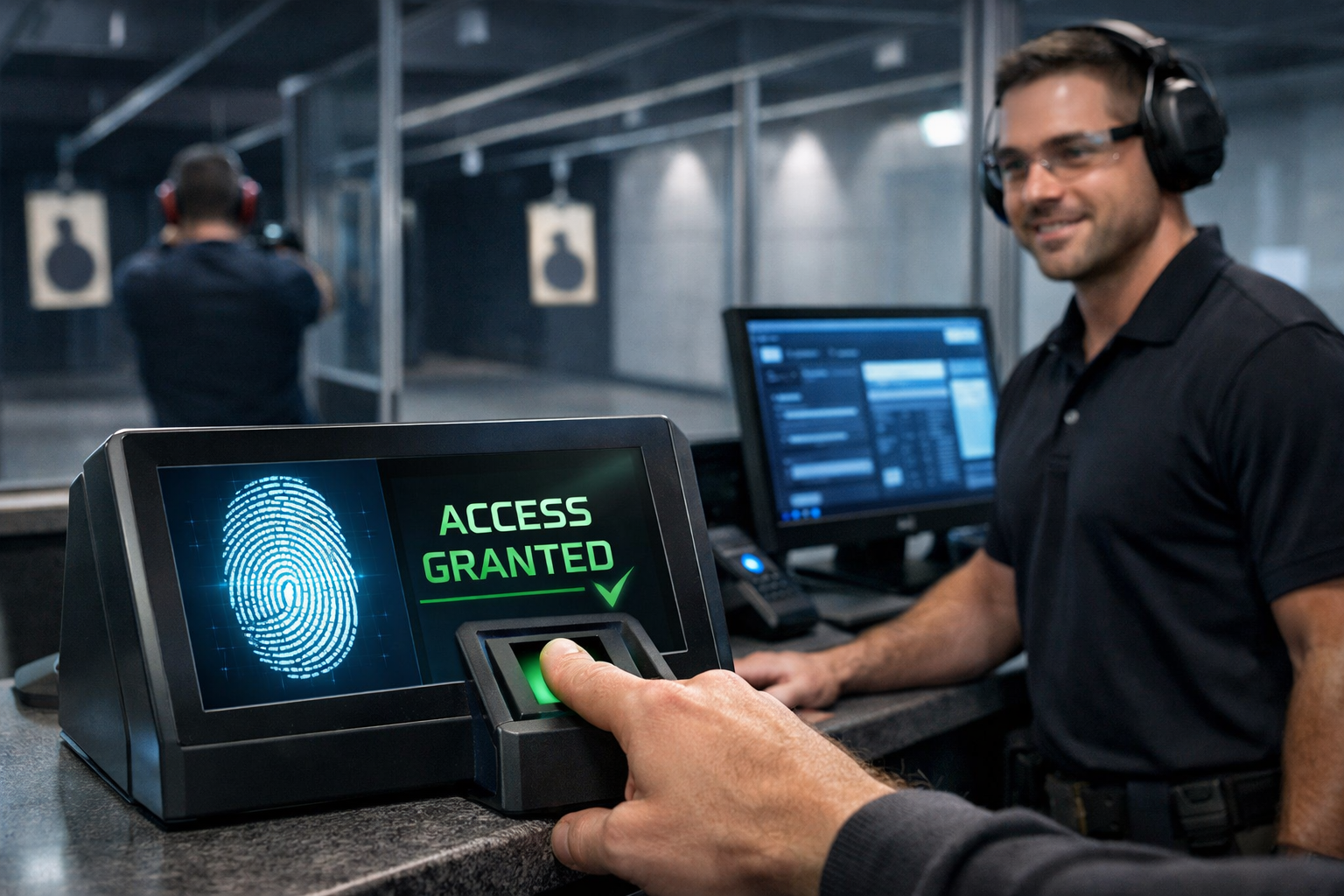
Every shooting range owner we talk to asks some version of the same question: “Will my customers really let a camera scan their face to check in?”
The answer is not a prediction. It is a data point. 176 million Americans already use facial recognition technology, and 132 million of them use it on at least one application every single day (CyberLink/YouGov 2024). Your customers are not being asked to adopt something new. They are being asked to use something they already trust—in a place where trust and security matter more than almost anywhere else.
The real question is not whether customers will accept biometrics at your range. It is how long you can afford to keep asking them to fill out paper waivers and wait in line while the rest of the consumer economy moves without them.
The Consumer Landscape: Biometrics Are Already Mainstream
Start with the device in your customer’s pocket. 68% of Americans use facial recognition to unlock their phone, laptop, or other device (CyberLink 2024). That is not an early adopter statistic. That is a majority behavior. Among 18- to 34-year-olds—the demographic every range needs to attract for long-term growth—75% have adopted facial recognition technology and 57% use it daily.
Move beyond devices, and the picture gets even clearer. 42% of Americans access banking services through facial authentication (GetSafeAndSound 2025). More than 53% of the total U.S. population engages with facial recognition systems regularly. The global facial recognition market reached $7 billion in 2024 and is projected to grow at 16% annually through 2028 (Market.us 2025). This is not emerging technology. It is infrastructure.
The CLEAR Effect: Security as a Consumer Brand
Perhaps the most powerful proof point for range owners is CLEAR. CLEAR has built over 33 million members by offering a simple value proposition: your biometric identity gives you faster, more secure access to airports, stadiums, and other controlled venues (CLEAR 2025). TSA PreCheck has grown to over 22 million active members (TSA 2025), with each member voluntarily providing fingerprints, photographs, and personal data in exchange for a Known Traveler Number that follows them everywhere they fly.
These are not tech enthusiasts. They are families, business travelers, retirees, and recreational consumers who decided that convenience and security were worth sharing their biometric data. If 55 million Americans have voluntarily enrolled in trusted traveler and biometric identity programs to skip a line at the airport, the idea that they will resist a similar system at a shooting range does not hold up to scrutiny.
Why Ranges Need Biometrics More Than Most Venues
A coffee shop can afford to rely on a credit card swipe. A shooting range cannot. Ranges operate in one of the most heavily regulated consumer environments in the country. Every customer who walks through the door must be verified for age, identity, and in many cases, waiver completion before they can access a live firing line. The current process at most ranges involves paper forms, manual ID checks, and front desk bottlenecks that create the longest wait times in the customer journey.
The Three Use Cases That Matter
Age-Gating and Compliance. Federal and state regulations require identity and age verification for firearm access. Biometric facial recognition provides instantaneous, tamper-proof verification that is more reliable than visual inspection of a driver’s license. It eliminates the risk of fraudulent IDs and creates a digital audit trail that protects the range in any compliance review. The financial services industry—with a 60–75% biometric adoption rate—has already proven this model at scale for Know Your Customer (KYC) requirements (OLOID 2025).
Fraud Prevention and Security. Ranges face unique security obligations. A biometric check-in system ensures that the person entering the range is who they claim to be—not someone using a borrowed membership card or a fake ID. Healthcare facilities, which have a 50–60% biometric adoption rate for patient identification, have demonstrated that biometric authentication reduces fraud and administrative error simultaneously (OLOID 2025).
Frictionless Access and Customer Experience. This is the argument that closes the deal for customers. 45% of consumers say they would adopt facial recognition specifically for convenience (CyberLink 2024). When a member walks in, the system recognizes them, confirms their waiver is current, verifies their age, and routes them to their lane or class—all before they reach the counter. No card to swipe, no form to sign, no line to stand in. This is the airport CLEAR lane experience applied to your lobby.
Addressing the Objection: What About Privacy Concerns?
Privacy is a legitimate conversation, and range owners should be prepared to have it. But the data tells a nuanced story. 89% of consumers are willing to share personal data with organizations—the question is under what conditions (Thales Digital Trust Index 2025). The conditions that build trust are transparency, control, and clear benefit.
Consumers who object to facial recognition in public surveillance do not necessarily object to it in private, voluntary contexts where they receive a direct benefit. The same CyberLink research that found mainstream adoption also found that the highest motivation for consumers to adopt facial recognition was the protection of their data, personal information, and assets (54%)—followed by convenience (45%) and improved safety (42%).
The Generational Lens
Consumer comfort with biometrics follows a clear generational line. 58% of all consumers are comfortable with facial recognition, iris scanning, and voice recognition systems (ElectroIQ 2024). Gen Z shows the highest acceptance rates. Baby boomers are more cautious but are adopting at increasing rates, particularly when the benefit is framed as security protection rather than data collection.
For ranges, this means the conversation is not about whether to adopt biometrics but how to frame the value proposition. When a customer hears “we scan your face to collect data,” they hesitate. When they hear “your face is your fast pass—no card, no line, and your identity is protected every time you visit,” they understand the benefit immediately. It is the same technology, positioned through the customer’s lens.
Cross-Industry Proof: Every Controlled-Access Venue Is Moving Here
Shooting ranges are controlled-access environments. So are airports, stadiums, hospitals, casinos, and hotels. Every one of these industries is adopting biometric identification, and the trajectory is identical: the self-service kiosk market reached $34 billion in 2024 (Grand View Research 2025), with kiosks increasingly integrating facial recognition and biometric authentication as standard features.
Casinos represent the closest analogy. Like ranges, they are regulated environments with strict identity requirements, age verification obligations, and security mandates. The casino segment holds the largest share of the self-service kiosk market at 22% (Grand View Research 2024), and casino kiosks now routinely integrate facial recognition for identity verification, loyalty program management, and access control. Range customers who visit casinos are already familiar with this interaction model.
Hospitals offer another compelling proof point. Geisinger Health Network introduced facial recognition for patient check-in across three facilities, registering thousands of facial profiles within months. The benefit: patients confirm identity with a single scan rather than repeating name, date of birth, and insurance information at every visit. The healthcare sector’s biometric adoption rate of 50–60% reflects the same dynamic ranges face: a regulated environment where accurate identification is not optional, and biometrics improve both security and experience simultaneously.
The Business Case: Speed, Staffing, and Scalability
Beyond customer acceptance, biometric check-in solves three operational problems that cost range owners money every day.
Speed. A biometric check-in takes seconds. A manual ID check, waiver review, and data entry process takes minutes. Multiply that difference across fifty customers on a Saturday morning, and you are looking at the difference between a lobby full of frustrated visitors and a range full of paying shooters. TSA reports that PreCheck members clear security in under 5 minutes compared to 20–30 minutes in standard lanes—a 75–83% reduction in processing time. Apply that ratio to your front desk.
Staffing. Every minute a front desk employee spends checking IDs and processing waivers is a minute they are not selling memberships, answering questions, or facilitating a great customer experience. Biometric systems handle the administrative transaction so your staff can focus on the human one.
Scalability. Paper-based check-in does not scale. As your customer base grows, your front desk becomes a bottleneck. Biometric systems scale infinitely—one kiosk handles the same workflow whether you have 500 customers or 5,000. The self-service kiosk market is growing at 10.9% annually because businesses across every industry have learned this lesson (Grand View Research 2025).
What Smart Implementation Looks Like
Successful biometric adoption is not about installing cameras. It is about designing a customer journey that makes the technology invisible and the benefit obvious.
Voluntary enrollment with clear benefit. Position biometric check-in as a premium experience, not a requirement. “Skip the line. Your face is your fast pass.” Customers who enroll get faster access. Customers who prefer traditional check-in still can. Over time, the convenience advantage converts the holdouts—exactly as it did with TSA PreCheck and CLEAR.
Transparent data practices. Tell customers exactly what data you collect, how it is stored, and who has access. The 87% of consumers who expect baseline privacy rights (Thales 2025) are not asking you to avoid collecting data—they are asking you to be honest about it. A simple, clear privacy statement at enrollment builds the trust that drives adoption.
On-device processing. The industry is moving rapidly toward edge-based facial recognition, where biometric data is processed locally rather than transmitted to the cloud. This approach improves both privacy and performance. 39% of new deployments are shifting to on-device processing (GetSafeAndSound 2025), and it directly addresses the most common consumer concern about biometric data security.
The Market Is Not Waiting
The facial recognition market is growing at 16% annually and is projected to reach $19 billion by 2032 (Market.us 2025). The biometrics market as a whole was valued at $41.58 billion in 2023 and is projected to reach $267 billion by 2033—a 20.4% compound annual growth rate (Cloudwards 2025). These are not speculative projections. They reflect the capital being deployed right now by the industries that have already made the decision your range is still debating.
Edge-based processing—where biometric data stays on the device rather than traveling to the cloud—is the fastest-growing deployment model, running at a 17.5% CAGR (Mordor Intelligence 2025). This architectural shift directly addresses the primary privacy concern consumers express: that their biometric data will be stored in a remote database vulnerable to breach. When the data never leaves the device, the concern becomes moot. This is the model purpose-built for environments like shooting ranges, where trust and security are the foundational brand promises.
Retail is already here. 63% of retailers have expressed interest in adopting contactless identification technologies, including facial recognition for self-checkout and customer analytics (IDEX Biometrics 2024). Financial services are already here—JPMorgan Chase and other major banks use biometric authentication for AML compliance and customer identification. Hospitality is already here—hotel operators report that 62% of customers agree facial recognition would enhance their experience, and 41% would be more likely to choose a hotel offering it (Market.us 2025). The shooting sports industry is not being asked to pioneer anything. It is being invited to adopt what every adjacent industry has already proven works.
The Implementation Roadmap
Phase 1: Voluntary enrollment at check-in. Offer biometric enrollment as an option alongside traditional check-in. Position it as the “fast lane.” Customers who enroll skip the line on every subsequent visit. This mirrors exactly how CLEAR launched—as a premium, voluntary experience alongside the standard process.
Phase 2: Waiver and compliance integration. Connect biometric identification to your digital waiver system so that identity verification, age confirmation, and waiver status are all checked in a single interaction. The customer scans once. Everything else happens automatically.
Phase 3: Full ecosystem integration. Link biometric check-in to membership management, lane assignment, retail POS, and the co-branded app. At this stage, a member walks in, is recognized, routed to their lane, and has their visit logged—all without touching a screen or speaking to a person unless they choose to.
The Bottom Line
Your customers already use facial recognition to unlock their phones, access their bank accounts, board their flights, and enter their offices. They have voluntarily enrolled in programs like CLEAR and TSA PreCheck by the tens of millions because the value equation—faster access, better security, less friction—is compelling enough to share biometric data.
The question for range owners is not whether customers will accept biometrics. They already have. The question is whether your range will be the one that delivers the experience they already expect—or the one that hands them a clipboard and a pen.
ShotPro’s biometric check-in technology integrates facial recognition with digital waivers, age verification, and membership management—giving your customers the fast-pass experience they already expect from every other venue they visit.
© 2026 ShotPro Technologies. All rights reserved.