
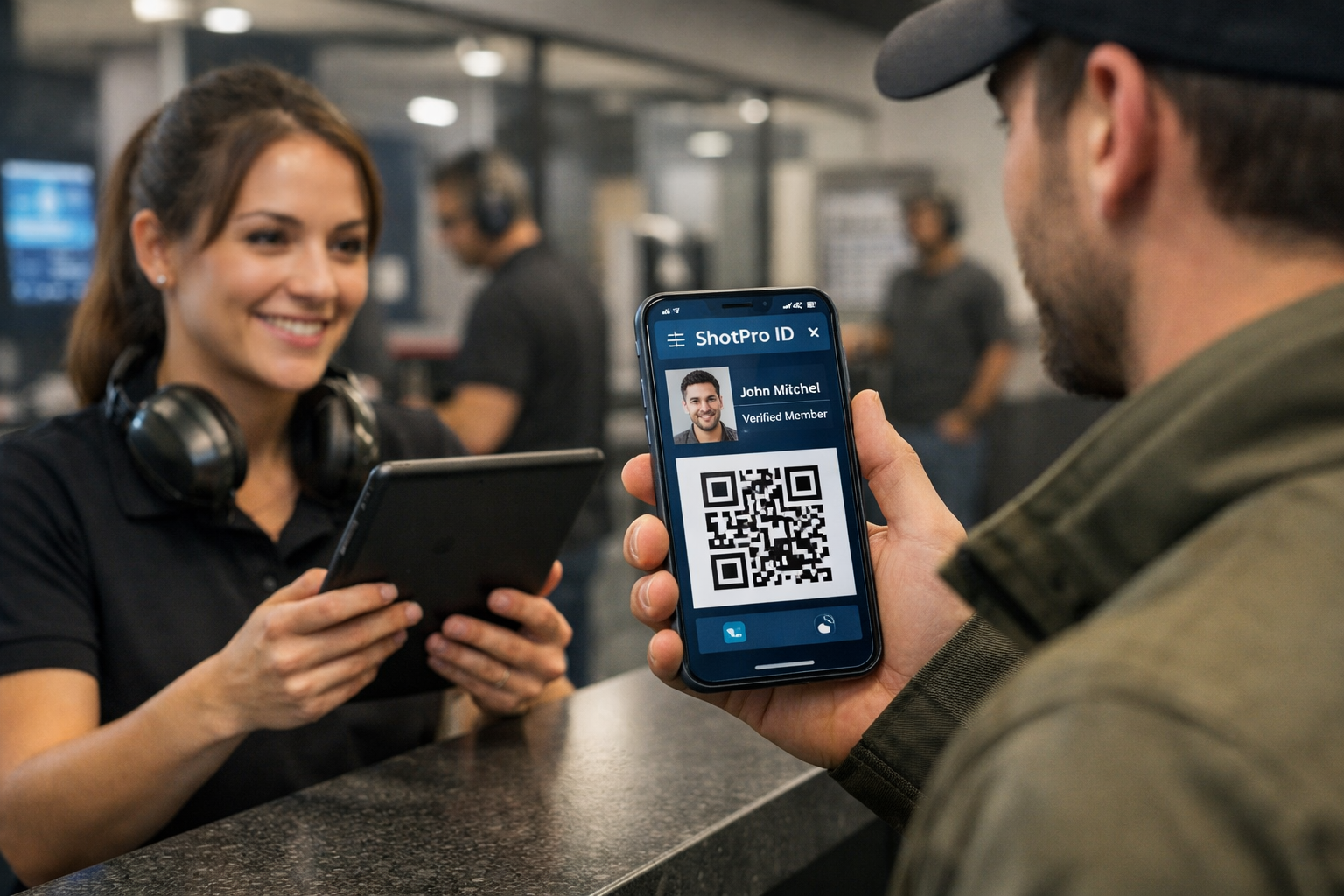
When you fly, you do not re-enter your name, address, date of birth, and government ID at every airport. You have a Known Traveler Number—a verified identity that follows you from airline to airline, airport to airport, coast to coast. You enroll once. You are verified once. And from that point forward, your identity works for you everywhere you go. TSA PreCheck has 22 million active members who made this choice (TSA 2025). CLEAR has over 33 million members who made the same one (CLEAR 2025).
Now apply that model to shooting sports. Today, a customer who visits three different ranges fills out three different waivers, provides three different copies of their ID, creates three different accounts, and starts from scratch at every front desk. Their visit history does not follow them. Their training certifications do not follow them. Their preferences do not follow them. Every range treats them like a stranger.
This is the problem a portable digital identity solves—and it is the same problem the travel industry solved a decade ago. A ShotPro ID is the Known Traveler Number for shooting sports: a single, verified digital identity that moves with the customer from range to range, securely managed and shared only with their explicit consent.
How the Known Traveler Model Works
The analogy to the travel industry is not a metaphor. It is a structural blueprint.
Enrollment
A customer creates their ShotPro ID at any participating range or through the ShotPro app. They verify their identity once—through government ID, biometric enrollment, or both. Their profile includes their verified identity, age, waiver status, membership tier, training history, and preferences. This is their digital passport for the shooting sports ecosystem.
Portability
When a ShotPro ID holder visits a new range, their verified identity travels with them—just as a Known Traveler Number works at any TSA PreCheck airport or a CLEAR membership works at any CLEAR-equipped venue. The customer does not re-enter their personal information. They do not fill out another waiver from scratch. They do not start over. The system recognizes them, confirms their credentials, and gets them on the range. Airlines pioneered this model through interline agreements and alliance networks (Star Alliance, OneWorld, SkyTeam) that allow a passenger’s status, preferences, and verified identity to flow seamlessly between carriers. Your ShotPro ID works the same way between participating ranges.
Consent-Based Sharing
This is where the model directly addresses the most important question range owners hear: “Who has access to my data?” The answer is built into the architecture: the customer’s ShotPro ID is shared with a range only once they become a Guest of that range. Until a customer checks in at your facility, you cannot see their profile. Once they do, you gain access to their verified identity, waiver status, and relevant preferences—exactly the way your information is shared between airlines when you book a connecting flight on a partner carrier.
This consent-based model mirrors the data-sharing frameworks that consumers already understand and accept. When you book through an airline alliance, you understand that your frequent flyer status, seat preference, and meal choice will be shared with the operating carrier. You accept this because it makes your experience better. The ShotPro ID operates on the same principle: data is shared in service of the customer’s convenience, not extracted for the platform’s benefit.
What Consumers Actually Think About Data Sharing
The Thales Digital Trust Index—a global survey of over 14,000 consumers—found that 89% of consumers are willing to share their personal data with organizations, provided certain conditions are met (Thales 2025). The conditions are not complicated: consumers want to know what data is being collected (55%), they want the right to have their data erased (53%), and they want control over what they share (30%).
The consumers who resist data sharing are not resisting the concept. They are resisting opaque, one-sided data practices where they provide information without understanding who uses it or how. The 37% of consumers who share data only because they have “no other option” (Thales 2025) are expressing frustration with platforms that force data collection without offering clear value in return.
A portable digital identity that the customer controls—where they can see exactly which ranges have access to their profile, revoke access at any time, and understand exactly what data is shared—is the opposite of the opaque model that erodes trust. It is the CLEAR model: voluntary, transparent, and built on a value exchange that the customer understands and accepts.
The Three Conveniences Customers Care About
1. Never Re-Enter Your Data
This is the convenience that drives TSA PreCheck enrollment and CLEAR adoption. Once you are in the system, you are done. 54% of consumers will abandon services that require cumbersome log-ins (Mordor Intelligence 2025). Every time a range asks a returning customer to fill out another form, they are adding friction that consumers are increasingly unwilling to tolerate. A portable identity eliminates this friction entirely—not just at your range, but at every range in the network.
Consider the healthcare analogy. Hospitals have adopted patient identity systems specifically to eliminate the “clipboard problem”—the absurdity of asking a patient to re-enter the same information at every visit and every provider. Healthcare has achieved a 50–60% biometric adoption rate (OLOID 2025) precisely because patients demanded relief from repetitive data entry. Range customers have the same frustration and the same expectation.
2. Seamless Movement From Location to Location
For customers who travel or who live between multiple ranges, a portable identity is transformative. A business traveler who shoots at a range near their office and a different range near their home should not have two separate accounts, two separate waivers, and two separate membership profiles. Their identity should work everywhere—the same way their airline loyalty number, their hotel rewards account, and their CLEAR membership work everywhere.
This is the network effect. Every range that joins the network makes the ShotPro ID more valuable to every customer who holds one—and every customer who holds one makes the network more valuable to every range. Airlines understood this when they built alliance networks. The entire point of Star Alliance is that a United frequent flyer who walks into a Lufthansa lounge in Frankfurt is already known. The same principle applies when a ShotPro ID holder walks into any participating range.
3. Access to Benefits, Protections, and Personalization
A ShotPro ID is not just a verification tool. It is a benefits platform. Verified members get faster check-in (the CLEAR lane equivalent). Their training certifications are recognized at every participating range. Their purchase history informs personalized recommendations. Their membership tier unlocks perks that follow them across locations.
The data supports this value proposition. 64% of consumers say trust in a brand increases when they see advanced technologies being used responsibly (Thales 2025). When customers see that their ShotPro ID gives them faster access, personalized service, and security protections—and that their data is handled transparently—they do not view the identity system as surveillance. They view it as a benefit they chose to enroll in. The same way CLEAR members view their membership: not as a data extraction tool, but as a service that makes their life better.
Security and Anonymization: The Architecture of Trust
For range owners concerned about liability and data security, the architecture matters as much as the concept.
Anonymized Analytics. ShotPro can provide ranges with aggregate analytics—visit frequency patterns, popular time slots, demographic trends, class demand signals—without exposing individual customer data. This is the same anonymization model used by financial services (60–75% biometric adoption rate) and healthcare (50–60% adoption rate) to generate actionable insights while protecting individual privacy. Range owners get the data they need to make better business decisions. Customers maintain control over their personal information.
Secure Storage and Compliance. The global digital trust market reached $482 billion in 2025 (Mordor Intelligence), driven by organizations investing in the infrastructure to manage identity data responsibly. A purpose-built identity management system provides encryption, access controls, and compliance frameworks that no range could build or maintain on its own. Centralizing identity management in a secure platform is not just more convenient for customers—it is more secure for ranges.
Customer Control. The customer can see which ranges have access to their profile, update their information from a single interface, and revoke access at any time. This is the “right to be informed” and “right to erasure” that 87% of consumers now demand as baseline privacy rights (Thales 2025). Building these controls into the platform from day one is not just good practice—it is the competitive advantage that separates trust-building platforms from data-extraction ones.
The Network Vision
Every range that participates in the ShotPro ID network benefits from the network itself. Customers who hold a ShotPro ID are pre-verified, pre-waivered, and pre-qualified—they require zero administrative processing when they walk through your door. They are also higher-value customers: consumers who invest in a verified identity are the same consumers who invest in memberships, training, and equipment. They are the shooting sports equivalent of the TSA PreCheck traveler who spends more at the airport because they arrive earlier and moves through faster.
And for the industry as a whole, a portable identity system elevates the perception of shooting sports from a fragmented, paper-based experience to a modern, technology-enabled ecosystem that takes identity, security, and customer experience as seriously as aviation, healthcare, and financial services do.
What the Range Owner Gets
The ShotPro ID is not just a customer-facing product. It is a business intelligence advantage for every participating range.
Pre-verified customers reduce your liability. Every ShotPro ID holder who walks through your door has already been identity-verified and age-confirmed. Their waiver is current. Their profile is complete. This eliminates the administrative risk of manual ID checks, incomplete waivers, and handwriting that no one can read. Your compliance documentation is digital, timestamped, and audit-ready—a meaningful advantage in one of the most regulated consumer environments in the country.
Richer customer data powers better decisions. When a customer’s visit history spans multiple ranges, the aggregate data tells a richer story than any single-range view. You can see that a new guest at your facility is actually a seasoned shooter who has completed advanced training at another range—information that changes how your staff greets them, what classes you recommend, and what products you suggest. This is the difference between treating every walk-in as a stranger and treating them as the experienced customer they actually are.
Network effects drive customer acquisition. Every range in the ShotPro network becomes a potential referral source for every other range. A customer who moves to a new city, travels for work, or simply wants to try a different facility is presented with participating ranges in their area—ranges where their identity, preferences, and membership benefits already work. This is how hotel loyalty programs drive bookings to specific properties: the network is the distribution channel.
The Trust Equation: Earned, Not Assumed
The Thales Digital Trust Index found that not one industry sector reached above 50% consumer trust with personal data in 2025—a sobering benchmark for any company asking customers to share sensitive information. But the research also revealed the formula for building trust: transparent data practices, clear consumer controls, and demonstrable benefit.
Companies that get this right see measurable results. Healthcare organizations earned 55% trust ratings for personal data handling—the highest of any sector—specifically because of strict compliance frameworks and visible data protection practices (Liquid Web 2025). The shooting sports industry has an opportunity to achieve similar trust levels by building identity management on the same principles: compliance-grade security, transparent practices, and customer control.
The question is not whether consumers will trust a portable identity for shooting sports. They already trust it for air travel, banking, and healthcare—industries where the stakes for data misuse are arguably higher. The question is whether the shooting sports industry will offer the same caliber of identity management that consumers have come to expect everywhere else.
The 55 million Americans who have voluntarily enrolled in trusted traveler and biometric identity programs did not do so because they were forced to. They did it because the value proposition was clear: enroll once, benefit everywhere, and trust that your data is handled responsibly. That is the ShotPro ID. And it is exactly what the next generation of range customers expects.
Continue Reading: The Modern Range Series
Will Customers Accept Biometrics at Gun Ranges?
Will Customers Use a Range App?
Self Check-In and Check-Out: The Kiosk Experience
Build a Brand, Not Just a Business
Top Marketing Priorities for Shooting Ranges
ShotPro’s portable digital identity platform gives every range customer a single verified profile that works across the entire ShotPro network—faster check-in, seamless movement between locations, and data security built on the same principles that power trusted traveler programs nationwide.
© 2026 ShotPro Technologies. All rights reserved.