
You board a flight without speaking to a person. You check into a hotel by tapping a screen in the lobby. You order food at a stadium kiosk and pick it up at the counter. You scan your own groceries, bag them, and walk out. In every controlled-access, high-throughput venue in America, self-service is not an alternative. It is the default. Over 66% of consumers now prefer self-service ordering over interacting with an employee (Deliverect 2025).
Shooting ranges are one of the last controlled-access consumer venues that still operate like it is 2005. A customer walks in, waits for a front desk employee, shows their ID, signs a paper or digital waiver, selects a lane, pays, and receives a briefing—a process that can take five to ten minutes at best, and twenty minutes during peak hours. Then they repeat a version of the same process on the way out.
The self-service kiosk market hit $34 billion in 2024 and is projected to reach over $62 billion by 2030, growing at 10.9% annually (Grand View Research 2025). That growth is being driven by one simple insight: 73% of customers say that valuing their time is the most important thing a business can do (Deliverect 2025). Your customers do not want to wait in your lobby. They want to get on the range.
Self Check-In: From Door to Lane in Under Two Minutes
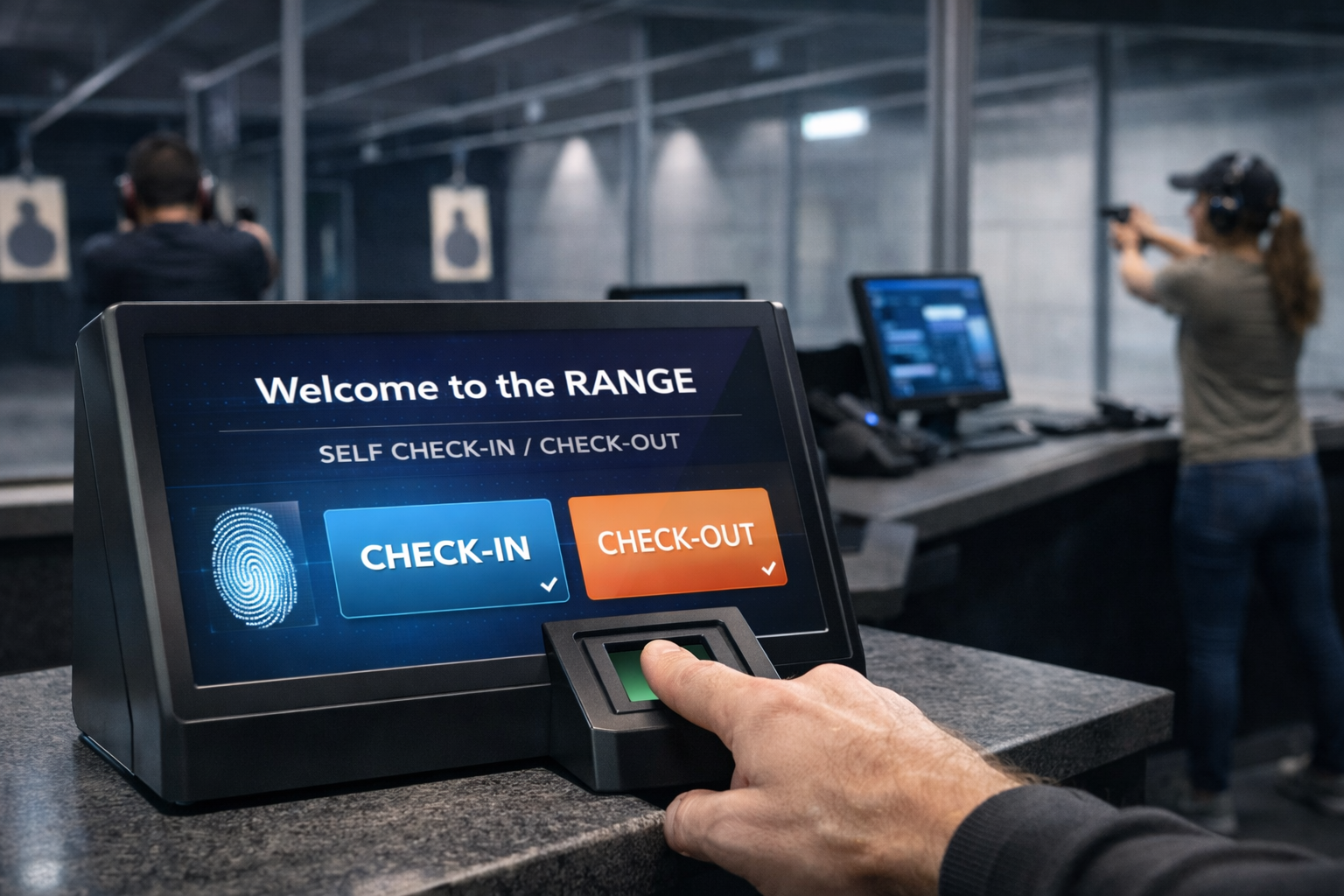
The self check-in kiosk eliminates the front desk bottleneck by handling the four administrative tasks that slow down every range visit: identity verification, waiver confirmation, lane assignment, and payment.
How It Works
A customer approaches the kiosk. If they are a returning visitor or member, the system identifies them—via facial recognition, membership card, QR code, or phone number—and pulls up their profile. Waiver status is confirmed automatically. The system displays available lanes, classes, or private instruction sessions. The customer selects their activity, pays if applicable, and receives a lane assignment. Total elapsed time: under ninety seconds. For first-time visitors, the kiosk walks them through waiver completion, ID verification, and profile creation in a guided flow that is faster and more accurate than a handwritten form.
This is not hypothetical. It is exactly how airports operate. TSA processes over 2.5 million passengers daily using a combination of self-service kiosks and automated identity verification. Hospitals have deployed self-service check-in kiosks in 35% of large facilities across 15 markets, achieving a 22% reduction in administrative queue time (360 Research Reports 2025). Hotels have driven occupancy rates to 72% globally in 2025 with self-service check-in systems that let guests bypass the front desk entirely (Prostay 2025).
The Routing Advantage
Self check-in does more than speed up access. It routes customers to the right experience. A walk-in customer checking in for open shooting gets assigned to an available lane. A customer arriving for their 10 AM Concealed Carry class gets directed to the classroom. A VIP member booking private instruction gets routed to their dedicated instructor. The kiosk does not just check people in—it manages the flow of your entire facility the way an airport manages the flow of passengers through terminals, gates, and boarding areas.
This routing capability becomes especially valuable during peak periods and events. When your range hosts a ladies’ night, a corporate event, and open shooting simultaneously, the kiosk directs each customer to the right place without your front desk staff serving as human traffic controllers. The result is fewer errors, less confusion, and a professional experience that signals to every customer that your range operates at a different level.
The Airport Analogy: Your Range Is Already a Terminal
Consider the modern airport experience in full. You check in on your phone before you arrive. You scan your boarding pass at a kiosk. You clear security through an automated lane. You buy food at a self-service station. You scan your pass again at the gate. The entire journey—from curb to seat—is designed around self-service touchpoints with human support available when you need it. This is not dehumanizing. It is efficient. And it is what consumers now consider standard.
Your range operates on the same model whether you realize it or not. A customer arrives (curb). They verify their identity (security). They are directed to their activity (gate). They participate (flight). They purchase retail products (terminal shops). They leave (baggage claim). The difference is that airports moved to self-service touchpoints at each step over the past two decades, and most ranges still handle every step manually. The technology exists to modernize each touchpoint. The customer expectation already demands it.
Self Check-Out: Buy, Receipt, Leave
The check-out side of the equation is equally powerful. After a range session, customers often want to purchase ammunition, targets, accessories, or apparel. The traditional process requires waiting for a sales associate, completing a point-of-sale transaction at the counter, and potentially waiting again if the staff member is helping someone else.
A self check-out kiosk lets customers scan products, complete payment by card or app, and display a digital receipt when they exit—the same model used by every major retailer from Walmart to Target. Retail self-checkout kiosks are growing at 16.2% CAGR (Mordor Intelligence 2025) because they solve the same problem for retailers that they solve for ranges: they keep the purchasing moment frictionless. When buying is easy, customers buy more. When there is a line, they walk out without buying.
Self-service kiosks across industries have demonstrated a consistent pattern: a 15% increase in order throughput in drive-thru deployments (360 Research Reports 2024), 28% improvement in operational efficiency in retail (Industry Research 2025), and 35% of service revenue generated post-deployment through upselling and cross-selling on the kiosk interface (360 Research Reports 2025). These are not marginal gains. They are structural improvements in how revenue flows through a venue.
The Staffing Equation: Fewer Transactions, Better Interactions
The most common pushback on kiosks is: “I don’t want to replace my staff with machines.” That misunderstands the value proposition. Self-service kiosks do not replace staff. They redirect staff from low-value administrative transactions to high-value human interactions.
When your front desk is no longer processing waivers and running credit cards, your team members can do the things that actually build loyalty: welcoming first-time visitors, recommending classes, conducting safety briefings with attention and care, upselling memberships in genuine conversation, and creating the kind of personal experience that turns a one-time visitor into a lifetime customer.
Hospitality operators facing double-digit wage inflation are adopting counter and drive-through kiosks at a 15.8% CAGR (Mordor Intelligence 2025) not to eliminate jobs, but to get more value out of every labor hour. The same logic applies to ranges. A range that processes 100 customers on a Saturday with two front desk employees and four kiosks delivers a better experience than a range that processes 100 customers with four front desk employees and zero kiosks—and it does so at lower cost.
Why Controlled-Access Venues Lead Kiosk Adoption
Shooting ranges share a critical characteristic with airports, hospitals, stadiums, and casinos: they are controlled-access environments where every person who enters must be identified, verified, and authorized before they can proceed. This is precisely why kiosks are most powerful in these settings. The administrative verification process is mandatory—it cannot be skipped. The only question is whether a human performs it manually or a system performs it instantly.
The casino industry—the largest segment of the self-service kiosk market at 22% market share (Grand View Research 2024)—has proven that consumers in regulated, security-conscious environments embrace self-service enthusiastically when it eliminates wait times. Airports deployed kiosk fleets in 48% of major international airports across 26 countries in 2025 (360 Research Reports 2025). Banking institutions upgraded 42% of branch kiosks to biometric authentication in 2024, reducing wait times by approximately 28% (360 Research Reports 2024).
In every case, the pattern is the same: regulated industry, identity verification requirement, high customer throughput, and a self-service solution that improves security, speed, and satisfaction simultaneously. Shooting ranges check every one of those boxes.
The Generational Expectation
38% of Gen Z and millennial customers say they are more likely to abandon a customer service interaction if it cannot be resolved through self-service (Gartner). This is not a preference. It is a deal-breaker. For the generation that represents the future of your customer base, a lobby that requires them to wait for a human to process a routine transaction is not quaint—it is a signal that your business has not kept up.
Meanwhile, 55% of all consumers prefer self-service kiosks for transactions specifically to reduce wait times(360 Research Reports 2025). That number is not skewed toward younger demographics alone. It spans every age group, driven by one universal truth: no one likes waiting in line. When you offer a faster path, people take it.
The Implementation Path
Start with check-in. The highest-impact, easiest-to-deploy kiosk function is self check-in—identity verification, waiver confirmation, and lane assignment. This alone eliminates the biggest friction point in your customer journey and gives your staff immediate capacity relief.
Add check-out in phase two. Once customers are comfortable with kiosk check-in, extend the experience to retail purchases and session check-out. The same interface, the same trust, a broader transaction scope.
Integrate with your app and membership system. The kiosk should recognize app users and members automatically, pre-populating their preferences and streamlining every interaction. This creates a unified experience: book on the app, check in at the kiosk, check out at the kiosk, and receive a push notification with a receipt and a recommendation for their next visit.
The ROI Case: Numbers That Close the Argument
Range owners evaluating kiosks should model the return across three dimensions: throughput, labor optimization, and incremental revenue.
Throughput. A single kiosk processes check-ins at approximately three to four times the speed of a manual front desk interaction. During peak hours—Saturday mornings, weekday evenings, event days—this throughput advantage translates directly to more paying customers on the range per hour. If your lobby bottleneck currently turns away or discourages five customers per weekend because the wait is too long, and those customers average $50 per visit, that is $13,000 in annual revenue you are losing to a process problem, not a demand problem.
Labor optimization. A front desk employee costs $15–$22 per hour depending on your market. A kiosk that handles check-in and check-out transactions for 60–70% of your customers during peak hours effectively gives you the equivalent of one to two additional staff members without adding payroll. The labor is not eliminated—it is redeployed to the high-value activities that actually drive revenue: selling memberships, conducting safety orientations, and delivering the personal interactions that build loyalty.
Incremental revenue. Kiosk interfaces can display targeted upsell prompts—membership offers for walk-in customers, class recommendations for frequent visitors, add-on products during checkout. The data from retail deployments is consistent: kiosk-based upselling generates measurable incremental revenue per transactionbecause the recommendation is presented at the moment of decision without the social pressure of a human upsell.
Security in a Controlled Environment
For range owners specifically, kiosks offer a security advantage that other venues do not require. When check-in includes identity verification and age confirmation, the kiosk creates a digital record of every person who enters your facility, their verified identity, and the time of their visit. This is not surveillance—it is the same compliance documentation that ranges already maintain, automated and made more accurate.
In an industry where accountability matters more than in almost any other consumer environment, a digital check-in system is not just a convenience tool. It is a liability protection tool. Every waiver completion, every age verification, every lane assignment is logged, timestamped, and stored—creating the kind of audit trail that protects your range in any legal or regulatory review.
Continue Reading: The Modern Range Series
Will Customers Accept Biometrics at Gun Ranges?
Will Customers Use a Range App?
Your ShotPro ID: The Known Traveler Number for Shooting Sports
From Click to Trigger Pull: Website
Analytics for Range Owners
ShotPro’s kiosk platform integrates self check-in and check-out with biometric identification, digital waivers, lane management, and retail POS—giving your customers the seamless, self-directed experience they already expect from every other venue they visit.
© 2026 ShotPro Technologies. All rights reserved.